Competing for a gamer's heart

July 11th, 2011 3:54 PM
by
Filed under History, Software showcase;
3 comments.

Popular culture abounds with tales of lovers lost to gaming addictions. Guys and gals who can't tear themselves away from World of Warcraft often emerge from their fantasy to find themselves without the partner they'd attracted offline.

Peter Molyneux. Photo by Daniel Alexander Smith.I never understood the competition some romancers feel toward electronic entertainment. Computer and video games can be great bonding experiences, whether you're playing cooperatively or competitively, or simply offering a passive experience for your partner to observe and enjoy.

Nonetheless, resentment has been a popular emotion engendered by gaming for longer than there have been MMORPGs — though role-playing games do tend to be a trend, as evidenced by Peter Molyneux's own tale. The creator of popular PC and Xbox games Populous, Black & White, and Fable was recently prompted to recall his first encounter with computer games:

The first proper game was probably Wizardry on the old Apple II. I totally became obsessed with that game, to the point where I lost my girlfriend by playing it – I left her down the pub three times! Because it was on floppy disk… Once, my floppy disk was written off and that night I immediately got in the car and I drove 150 miles to find another Wizardry player so I could get a copy of the disc. It was the first game really that I ever played with levelling-up. It was set in a dungeon, and there was a mad god, and it had spells. It was wireframe, but in my imagination I was down there in that dungeon.

Given the career and status this famed developer has attained since being inspired by that Apple II game in 1981, it's certainly the girlfriend's loss to have not seen the potential in that marriage.

Have you ever had to curb your gaming enthusiasm to placate your partner? What have you done to try to turn a paramour into a player?

(Hat tip to Neon Kelly)

Out of this World for iOS

March 10th, 2011 9:06 AM
by
Filed under Software showcase;
no comments yet.

In the latest episode of Open Apple, Mike and I noted both that the 25th Game Developers Conference was held last week in San Francisco, and that iOS is becoming a great platform for retrogaming. I didn't realize at the time that there was a recent intersection of those two topics: Out of this World, a classic Apple IIGS game, is coming to iOS.

As reported by Touch Arcade, Éric Chahi, the game's original developer, made the announcement at GDC that Out of this World, known overseas as Another World, will arrive on the iPad and iPhone at an unspecified future date.

At the time of its 1991 release, when 16-bit graphics weren't quite realistic enough, this puzzle-platform game from Interplay used rotoscoping techniques to transport the earthly scientist Lester Knight Chaykin to an alien planet. Each non-scrolling screen presented a different puzzle and a part of the narrative of his adventure to return home. Surrounded by foreign technology and unintelligible lifeforms, Lester's journey is one of beauty and inscrutability.

I enjoyed OotW on the Super Nintendo but found it a relatively short game once mastered. In my recent attempts to replay it, I found it rather obtuse and far from what modern gamers would expect from what is ostensibly an action game. In my former career as a high school teacher of technical writing, I thought OotW would be a perfect case study: give it to students without instruction, and have them write the documentation from scratch. Trying to decipher the game in both internal and external contexts would've been fascinating. Unfortunately, such an assignment was impossible due to predating the game's many freeware ports.

I did eventually beat this game on the SNES but was dismayed to find its cliffhanger of an ending unresolved; the squel, Heart of the Alien, was released only for the ill-fated Sega CD console system, limiting its accessibility. But maybe, if the series' first half sells well on iOS, it won't be long before we finally see the resolution of Lester's quest.

UPDATE: The video, audio, and slides from this GDC presentation are now available.

(Hat tip to Blake Patterson and Jason Scott)

Castle Wolfenstein painting for auction

February 14th, 2011 10:38 AM
by
Filed under Software showcase;
1 comment.

Growing up with the Apple II, I enjoyed the computer more as a games machine than anything else. Sure, punching numbers into Visicalc or writing short stories in Apple Writer can be fun, but not so captivating to a five-year-old's imagination as Choplifter or Lode Runner.

One game that made an impression like no other was Castle Wolfenstein. Eleven years before its 3D successor, this Apple II game was spouting synthesized German at players as they made their way through a Nazi stronghold. I would wake up Saturday mornings before the rest of my family to play this game, and to have the pre-dawn silence suddenly broken by a stormtrooper bursting into the room and screaming at me was nerve-wracking. Castle Wolfenstein and Silent Hill are the only games that have made me so scared, I wanted to turn off the system. It's a powerful legacy for its late creator, Silas Warner, to have left.

Now, a piece of that history is up for auction. The box art for Castle Wolfenstein was based on an original painting which is currently listed on eBay. Here are the details:

Castle Wolfenstein paintingThis is the original painting by John D. Benson used as the cover for Muse Software’s 1981 game “Castle Wolfenstein” – the game that inspired id Software’s “Castle Wolfenstein 3D”! Castle Wolfenstein is the first in the genre of stealth-based computer games. Created by Muse software, it was available on the Apple II, DOS, Atari 8-bit family and the Commodore 64.

[The piece is for sale by Walter Costinak, who] was an incredibly successful video-game web designer, having created sites for id Software, Activision, Ritual Entertainment and many more. About nine years ago he bought this painting on eBay for his personal collection from someone who had acquired all the art from Muse's assets.

The original artist has contact me to let me know the painting is done with Alkyd Oils, not watercolor.

The dimensions of the piece (including matte and frame) are 27 1/4 inches by 23 1/4 inches. Also included are the original C64 manual and game disk (NOTE: disk slipcover is *not* original, and I don’t know if the disk still works).

Proudly show off the retro gaming geek that you are and hang this is your home, office, boardroom, or subterranean lair! Good luck on your bidding, schweinhund!

Although the artwork itself may not be a masterpiece, its historical value is at least that of its current bid, which at the time of this writing hasn't increased from $305 in the last 48 hours. I'll be watching this auction with more than a passing interest. Best of luck to all bidders!

(Hat tip to Andy Chalk)

Academic Ultima

October 7th, 2010 12:20 PM
by
Filed under Musings, Software showcase;
7 comments.

Before my current job at Computerworld, I taught 11th grade tech writing at a math and science charter school. My fellow teachers had an open door policy that allowed me to observe their classes, and I developed a rapport with the computer science teacher. When an emergency called her away from class one day, she asked me to fill in but left me no lesson plan. Fortunately, I'd already installed both Adventure and VisiCalc for just such an emergency. The resulting lesson in computer history was reported in Juiced.GS, though I never did get the opportunity to explore Adventure with my students.

But other educators have had the opportunity to use electronic entertainment as a learning tool. Besides the use of interactive fiction in a classroom setting, as detailed in Get Lamp, Michael Abbott has taken a more ambitious approach to virtual adventuring by introducing his students to Richard Garriott's seminal role-playing game, Ultima IV: Quest of the Avatar.

In his blog, the teacher doesn't outline his learning objectives, other than puzzle-solving and note-taking. I hope his goals were not much loftier than that, because it seems these students disappointed him:

It mostly came down to issues of user-interface, navigation, combat, and a general lack of clarity about what to do and how to do it. … it [wa]sn't much fun for them. They want a radar in the corner of the screen. They want mission logs. They want fun combat. They want an in-game tutorial. They want a game that doesn't feel like so much work.

Ultima IV: Quest of the Avatar

That looks like a lot of reading!
Photo courtesy Blake Patterson.

I'm unsure how many of these obstacles were inherent to the game, and how many were symbolic of a generational gap. Today, I often want a game that immerses me within the first five minutes, and which I can put down after ten. That means either simple gameplay (in the case of classics like Pac-Man or Qix) or familiar gameplay (like Dragon Quest VIII, an RPG I played hours on end for a total of 80, but whose mechanics had remained largely unchanged since the franchise's origin in 1986).

I was not always predisposed against learning curves. I grew up playing and enjoying Ultima, but not on the Apple II. I was and am primarily a console gamer, and I played these games' Nintendo adaptations, which vexed me with none of the issues that these students encountered. I wondered how dramatically different the NES version had been that maybe it had eased my entry into Britannia. Sure enough, one blog commenter wrote:

… have you considered giving people the NES port of Ultima IV? It faithfully retains the ethical systems design of Garriott's original while reimagining the visual aesthetics and interface design according to the conventions of JRPGs. It was how I played Ultima IV back in the day, and it's still probably a lot more in line with modern RPG convention than the original PC Ultima IV.

But I'd wager that most alumni of Ultima IV experienced it on the computer, which apparently did not preclude its success, so surely its original interface was not insurmountable. More likely is the change in gaming mores over the decades. In the book Dungeons & Dreamers, authors Brad King and John Borland relate the detail and intricacy with which the developers of Ultima Online imbued their world. Ecology, economy, and more were devised to create a world that lived and breathed along with the players. When it finally launched — the world was shot to hell. Gamers traveled into the countryside, burning trees and killing animals. No plane could long host such chaos, so the developers had to go back to the drawing board. I suspect Mr. Abbott's students would likely have contributed to that headache.

Nonetheless, I hope the blog's conclusion does not spell the end of this exercise: "I love great old games like Ultima IV, but I can no longer assume the game will make its case for greatness all by itself." Just as we have courses in art and music appreciation, it's important to understand and appreciate the origin of Ultima and other video game hallmarks. Today's gaming industry was not born in a vacuum, and just as the bold experiments of yesteryear determined the future of the genre, they still have much to teach today's gamers and programmers about what works, what doesn't, and why things are the way they are. Finding a context in which to teach that lesson is, much like the games themselves, worth the effort.

(Hat tip to Richard Garriott)

Alderaan Trail

September 20th, 2010 1:23 PM
by
Filed under Software showcase;
no comments yet.

Oregon Trail, having recently enjoyed a successful film adaptation, is now being adapted to a variety of other media. The first is a mashup with another storied film franchise:

Alderaan Trail Shoppe
But I was going to Tosche Station for some power converters!
Image copyright Matt Marchini.

Sadly, this is one of several pictures that are not screen shots from an actual game, but mockups of a theoretical one. From the photo album's description:

A long time ago in a galaxy pretty far away… As a galactic civil war rages on, the escalating violence in your system has reached new heights. Seeking a better life you and a small band of compatriots set out on a perilous journey to find a new home. Alderaan, a small blue planet know for it's civility ( it is said by many that they have no weapons) would make the perfect retreat for your loved ones hoping to avoid Imperial entanglements. Untold danger awaits you on… THE ALDERAAN TRAIL.

A version that's closer to the original in setting but a far cry in genre is So Long, Oregon! for iOS. Here's a trailer for this side-scrolling shooter:

Also available for the iPhone is Oregon Trail itself, which was reviewed in the March 2010 issue of Juiced.GS. More affordably, if you want to play a modern retelling, check out Thule Road Trip online, as detailed in my KansasFest 2009 presentation.

In whatever era or medium you play this classic game, you'll likely find it harder than you remember. Rather than mourn your inevitable failure, celebrate that you were able to experience even a fraction of the glorious Oregon Trail:

epic fail photos - Cake WIN

(Hat tip to Bob's House of Video Games)

The physics of Tetris

September 6th, 2010 11:18 AM
by
Filed under Software showcase;
no comments yet.

It wasn't until 1989 that I first encountered what I identified as a puzzle game: Adventures of Lolo on the 8-bit Nintendo Entertainment System. That was the same year as the release of the Nintendo Game Boy, whose pack-in title, Tetris, was a far more common introduction to the genre for most American gamers. And it was this game that the legendary Steve Wozniak became a master of, to the point of his high scores being printed in Nintendo Power magazine.

Though it was Nintendo's handheld system that popularized the Russian puzzler, the software had already been making the rounds on various computer platforms. In 1988, Spectrum Holobyte (1983–1998) released the Apple II version, which actually came on three disks, one for each operating system: DOS 3.3, ProDOS, and GS/OS. No matter what version you played or what system you played it on, Tetris was an addictive experience, due in part to a variety of subtle yet effective psychological qualities that perfectly complement humans' natural capabilities and limitations. Not only did gamers start seeing tetrads everywhere they looked, but the game had actual, physiological, positive impact on the human brain.

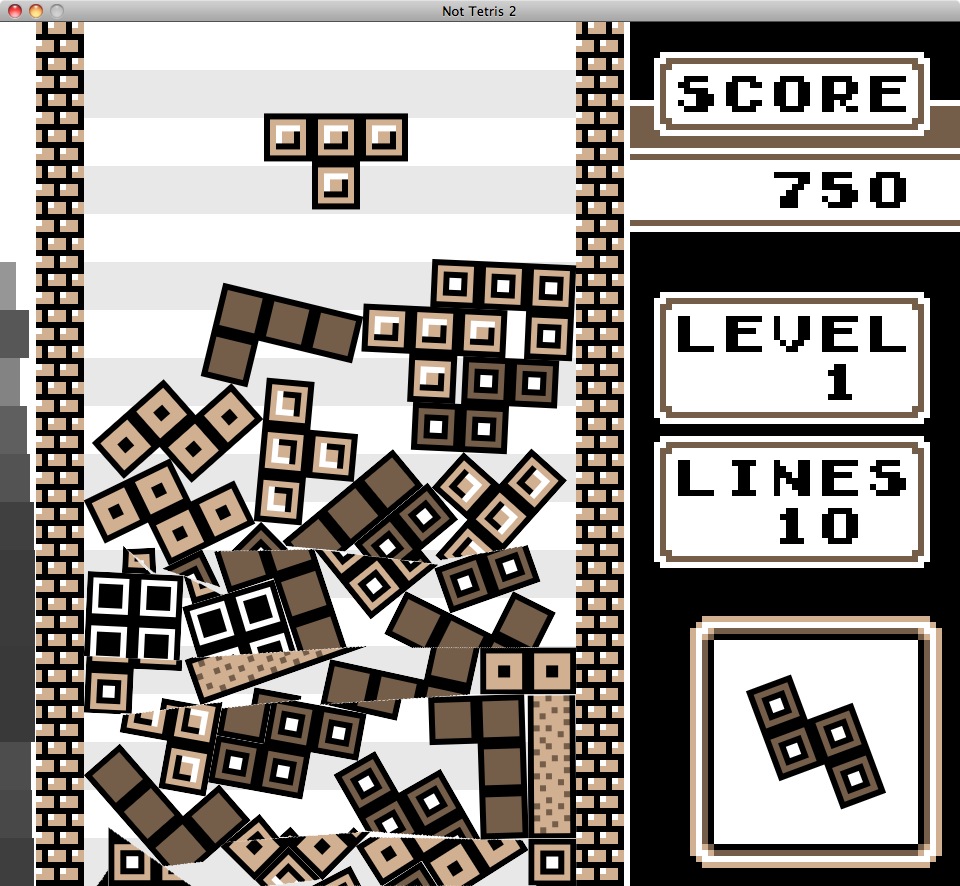
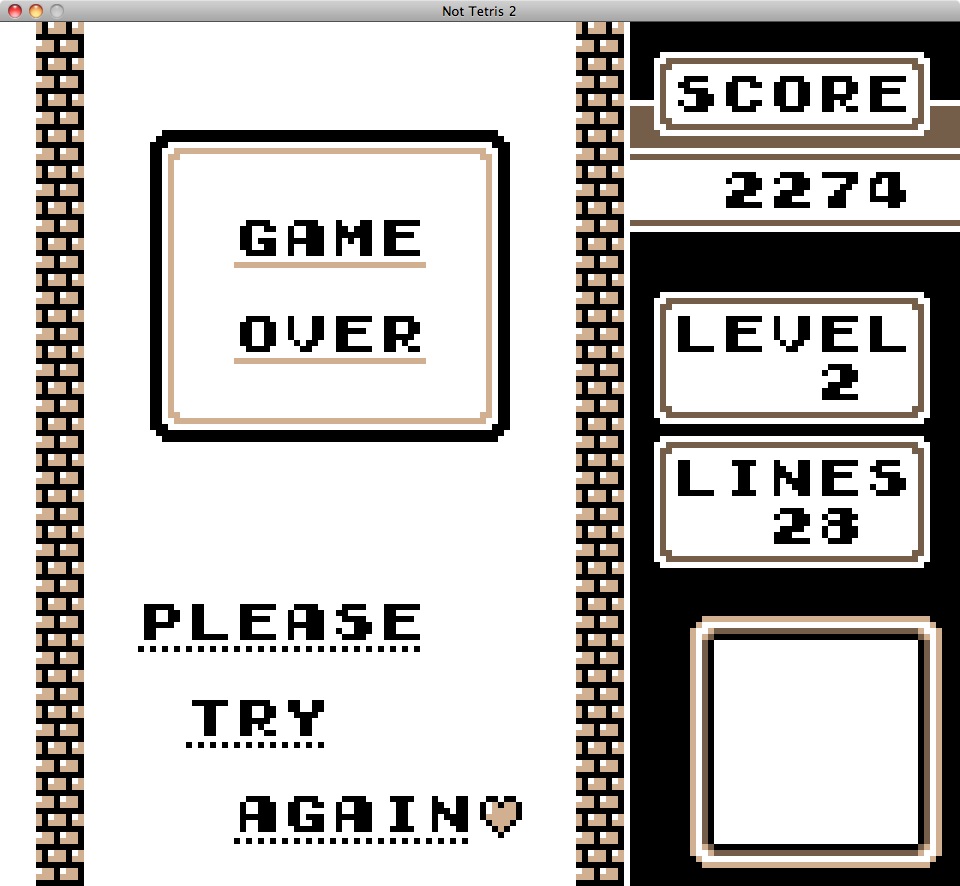
A game with so many scientific implications cries out for further study and applications. Software developer Maurice Guegan has answered that call with a fascinating and hilarious variation that he has dubbed Not Tetris. The game, a free download for Windows (and, when paired with a utility called LÖVE, for Mac and Linux), applies some degree of real-world physics to the falling blocks. Not only does this newfound inertia make it more difficult to rotate the pieces, but gravity makes it nearly impossible to form complete lines. In fact, Guegan has completely disabled that functionality, replacing it with a new goal of seeing how many game pieces you can stack before the inevitable game over.

Having a hard time visualizing this new spin on the classic formula? Here's some gameplay footage.

Not Tetris is worth a play for its original and innovative take on Tetris. For more standard gameplay, the GNO Apple II Archive has entire folders in both its Apple II and Apple IIGS games directories dedicated to Tetris clones, including Dreamworld's most excellent two-player DuelTris.

If that's not quite retro enough for you, check out Tetris creator Alexey Pajitnov's original Tetris. For more about Tetris's tangled history, see the chapter "From Russia With Love" in David Sheff's excellent history of Nintendo, Game Over: Press Start to Continue.

(Hat tip to Nintendo Life: Retro)